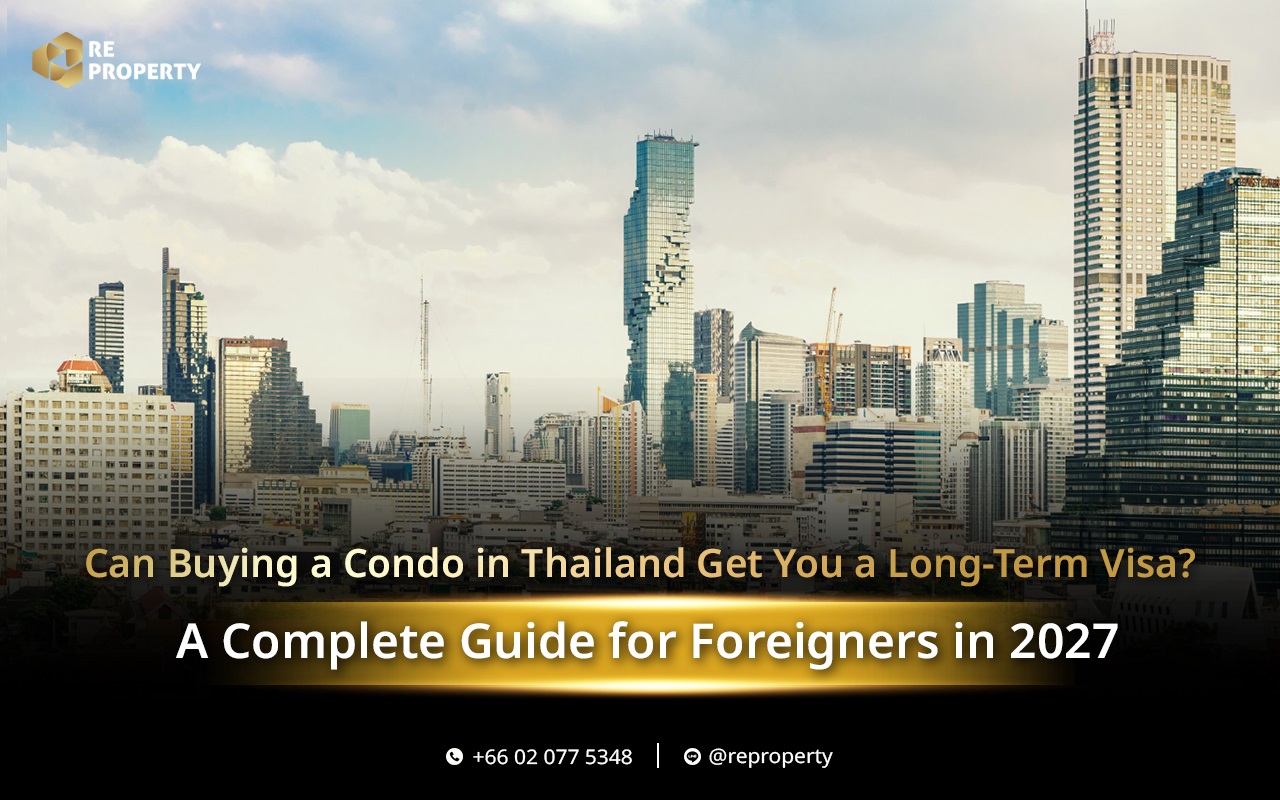
Buying a condominium in Thailand can be an attractive option for foreigners who want a home in Bangkok, a long-term base in the country, or a property they may eventually rent out or sell. But one important question often comes first: can purchasing a condo also help you stay in Thailand long term?
Thailand offers several long-stay visa options, and foreign nationals can legally own qualifying condominium units under specific conditions. However, these are two separate matters. Buying a condo does not automatically grant a Thai visa, permanent residency, or permission to stay indefinitely.
For anyone considering a move to Thailand in 2027, understanding the relationship between property ownership, immigration rules, and the property market is essential. This guide explains the main rules, possible visa routes, investment considerations, rental opportunities, and what to think about before purchasing a property.
Important note: This article is a planning guide for 2027 based on rules and information available as of November 2026. Immigration requirements, fees, and property regulations can change. Confirm the latest requirements with the relevant Thai authorities and an independent Thai lawyer before making a decision.
Foreigners can buy and own certain types of property in Thailand, but the rules depend on the property type and ownership structure.
The most straightforward route for foreign freehold ownership is generally a condominium unit in a building registered under Thailand’s Condominium Act.
Under the foreign ownership quota, foreign nationals may collectively own no more than 49% of the total saleable area of a qualifying condominium building. The remaining ownership must comply with the applicable Thai ownership requirements.
This means a foreign buyer can potentially own a condominium unit in their own name, provided the building has available foreign quota and the buyer meets the legal requirements.
Property type | Foreign ownership position |
|---|---|
Condominium | Freehold ownership generally permitted within the foreign quota |
Land | Direct foreign freehold ownership generally restricted |
House on leased land | Possible, subject to the legal structure and land rights |
Leasehold property | Lease rights may be available under Thai law |
Property through a Thai company | Requires genuine legal and business compliance; nominee arrangements are not a lawful workaround |
A condominium purchase is therefore often more straightforward for foreign buyers than purchasing a house with land.
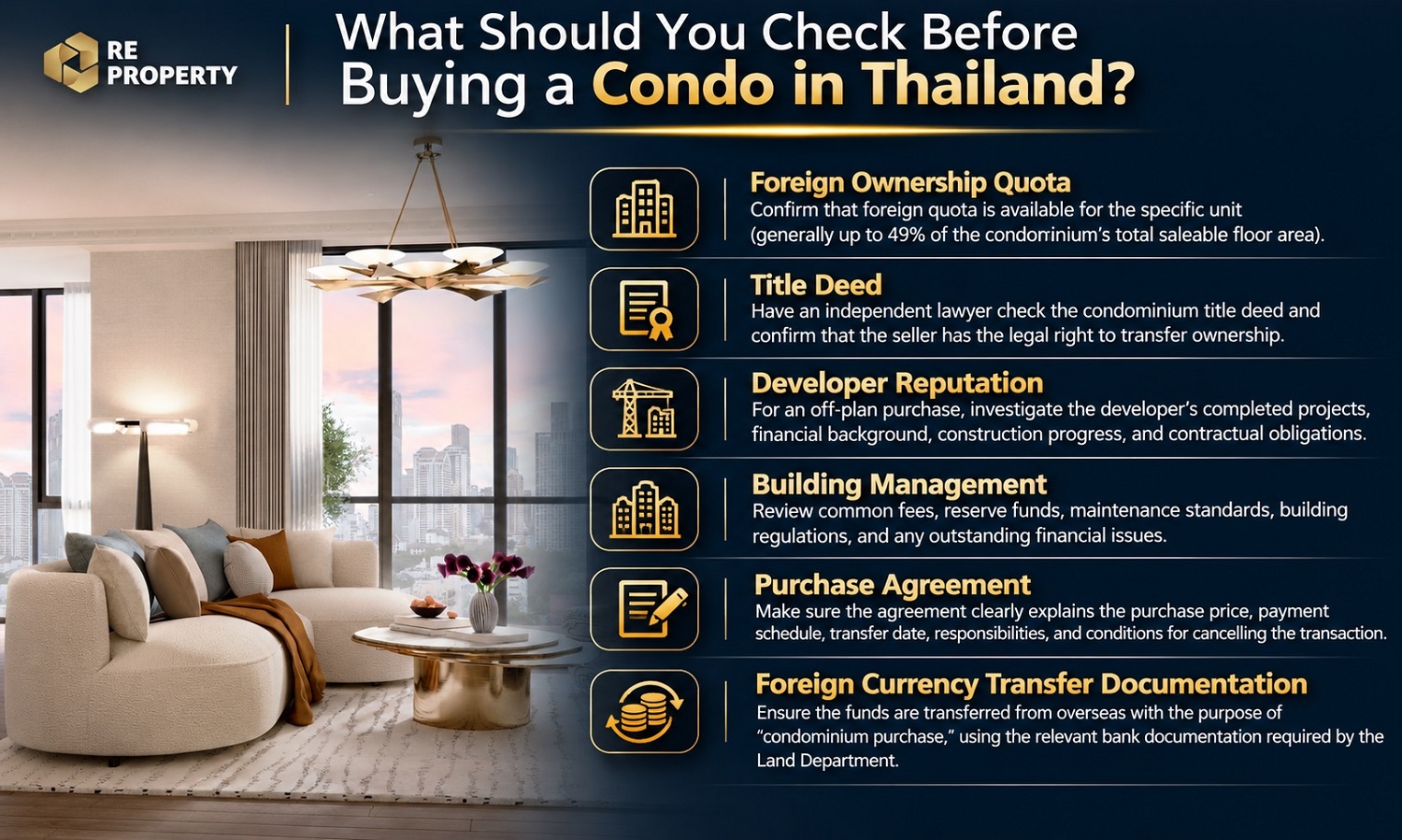
Before paying a reservation fee or signing a purchase agreement, buyers should verify the condominium’s foreign ownership quota, title deed, developer or seller’s ownership, and the required documentation for transferring ownership.
Take a look at some of our luxury properties in Bangkok
This is one of the most common questions among foreigners considering property ownership in Thailand.
The short answer is no. Buying a condominium does not automatically qualify a foreigner for a retirement visa, permanent residency, or an unlimited right to stay in Thailand.
Property ownership and immigration status are governed by different rules.
A foreigner may own a qualifying condominium while living outside Thailand, or may live in Thailand under a visa that has no connection to property ownership.
However, certain immigration programmes have investment criteria that may recognise qualifying Thai property investments. This is different from receiving a visa simply because you purchased an ordinary condominium.
For example, the Long-Term Resident (LTR) Visa includes a category for qualifying wealthy global citizens, with specific investment and financial requirements. A qualifying Thai property investment may form part of the investment criteria, but purchasing a condo alone is not enough.
The important distinction is:
A buyer should never assume that a property purchase will automatically solve their long-term immigration needs.
If your goal is to live in Thailand for several years, there are several immigration routes worth understanding. The right option depends on your age, financial position, employment, professional background, and intended length of stay.
Here are the main options to consider for 2027.
The LTR Visa is a programme designed for certain qualified foreign nationals who want to live in Thailand long term.
It has four main categories:
The Wealthy Global Citizen category is particularly relevant to property investors.
According to the published BOI requirements, applicants must generally demonstrate:
At least USD 1 million in total assets.
A qualifying condominium investment may therefore contribute towards the investment requirement. However, the applicant must also satisfy the other financial, insurance, and immigration conditions.
The LTR programme provides a potential long-term stay of up to 10 years, subject to its conditions and renewal arrangements.
Foreigners aged 50 or older may be eligible for retirement-related visa options.
The financial requirements commonly include one of the following:
The O-A route also has health insurance, medical, criminal record, and other documentation requirements.
A retirement visa is not based on purchasing property. You can own a qualifying condominium and separately apply for a retirement visa if you meet the relevant requirements.
Requirements can differ according to the visa category, nationality, and place of application, so applicants should check the relevant Thai embassy or consulate
Thailand Privilege is a membership-based programme for people who want an extended stay with additional services and privileges.
It is not a property investment visa. You do not need to buy a condominium to apply.
The published membership options include:
Membership | Published fee | Validity |
|---|---|---|
Bronze | THB 650,000 | 5 years |
Gold | THB 900,000 | 5 years |
Platinum | THB 1,500,000 | 10 years |
Diamond | THB 2,500,000 | 15 years |
Reserve | THB 5,000,000 | 20 years |
Fees and packages are published programme information available in November 2026. Confirm the current offer, eligibility, and benefits directly with Thailand Privilege before applying.
For someone who wants to live in Bangkok without committing to a property purchase, this is an alternative worth comparing.
The Destination Thailand Visa is designed for eligible remote workers, digital nomads, freelancers, foreign talent, and people participating in specified Thai soft-power activities.
The published application requirements include evidence of financial funds of at least THB 500,000, alongside documentation relevant to the applicant’s purpose.
The DTV is not a property ownership visa. Buying a condominium does not replace its eligibility requirements.
Applicants should also check the latest documentation requirements at the Thai embassy or consulate where they apply.

Foreigners who plan to work for a Thai company or operate a qualifying business may have other immigration routes, including the Non-Immigrant B visa and relevant work permit arrangements.
These routes are based on employment or business eligibility, not simply on owning a condominium.
Visa option | Main eligibility basis | Is buying a condo required? |
|---|---|---|
LTR | Financial, investment or professional criteria | No, but qualifying property can count for one category |
Retirement | Age and financial requirements | No |
Thailand Privilege | Paid membership and programme conditions | No |
DTV | Eligible workcation or activity purpose and financial evidence | No |
Non-Immigrant B | Qualifying employment or business purpose | No |
The important takeaway is that there is no universal minimum condominium purchase price that automatically gives a foreigner a Thai long-term visa.
This is where many property buyers become confused.
Some people hear that purchasing a condominium worth USD 500,000 can help with a Thai visa and assume that spending this amount automatically provides long-term residency.
That is not correct.
The USD 500,000 property investment figure relates to one part of the LTR Wealthy Global Citizen eligibility requirements.
For this category, the published BOI criteria also require at least USD 1 million in total assets and qualifying health insurance, Thai social security coverage, or an eligible bank deposit.
The property investment must be held in the applicant’s own name and meet the programme’s conditions.
You can still purchase a qualifying condominium in Thailand without meeting the LTR Wealthy Global Citizen investment threshold.
For example, a foreign buyer may purchase a condominium in Bangkok for THB 5 million, THB 10 million, or THB 20 million, subject to the applicable ownership rules.
That purchase does not automatically provide a visa, but the buyer may independently qualify for another immigration category.
This distinction is particularly important for people who want to move to Thailand but do not intend to make a USD 500,000 property investment.
Think of property ownership and visa eligibility as two separate decisions. You should first determine which immigration route you qualify for, then decide whether purchasing a property makes financial sense.
Buying a condominium can make sense for someone who expects to spend many years in Thailand, wants a permanent home base, or prefers ownership over paying rent.
Bangkok offers a wide range of residential options, from smaller city condominiums to spacious luxury residences and private penthouses.
However, the decision should be based on more than the purchase price.
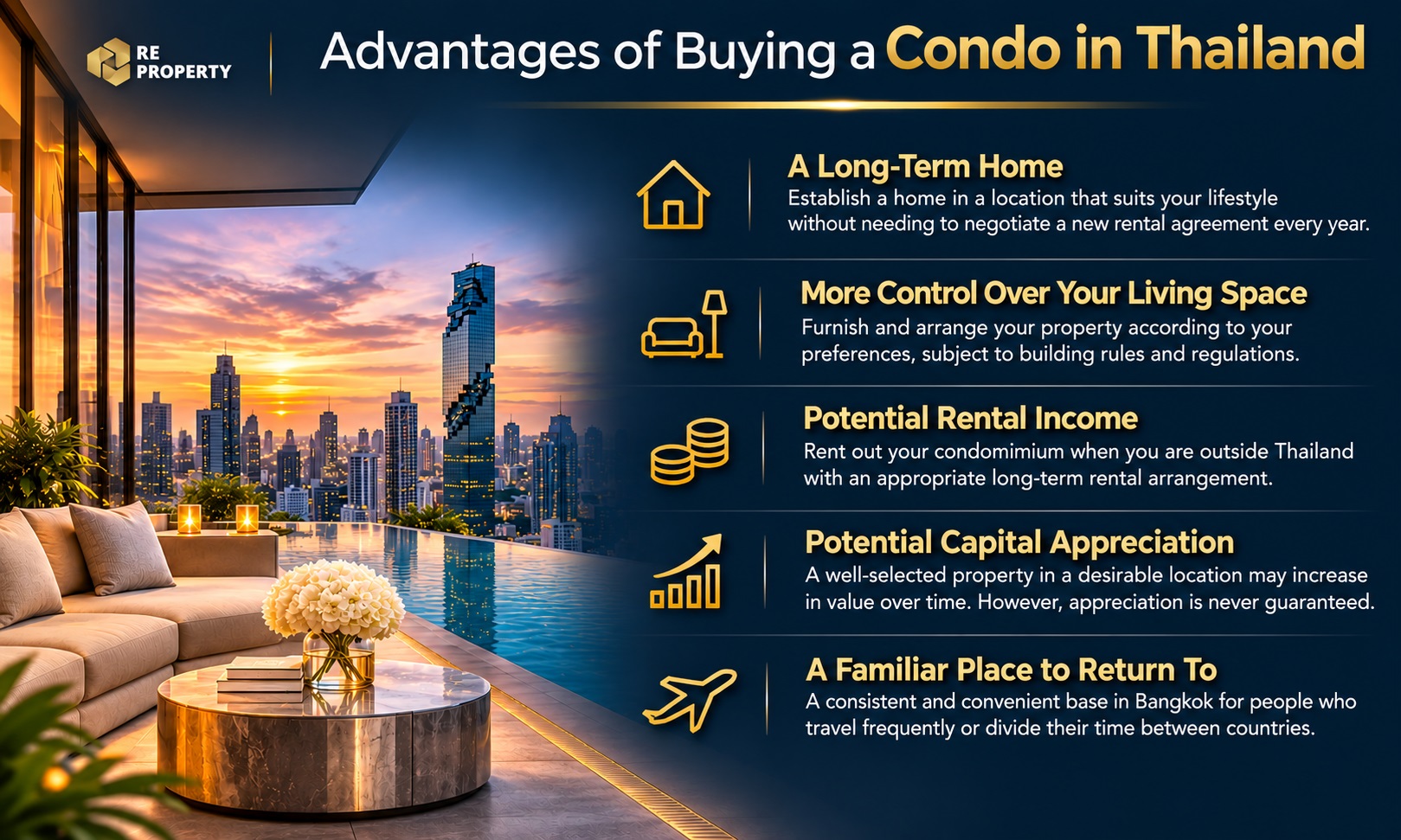
Buying also involves financial and practical responsibilities:
A condominium is not automatically a better financial choice than renting. The answer depends on how long you plan to stay, the purchase price, the rental alternative, and the future resale prospects.
Thailand has a legal framework that allows qualifying foreign condominium ownership. However, buyers should carry out independent due diligence before committing money.
The fact that a property is advertised by a developer or real estate agent does not mean every legal and financial detail has already been checked.
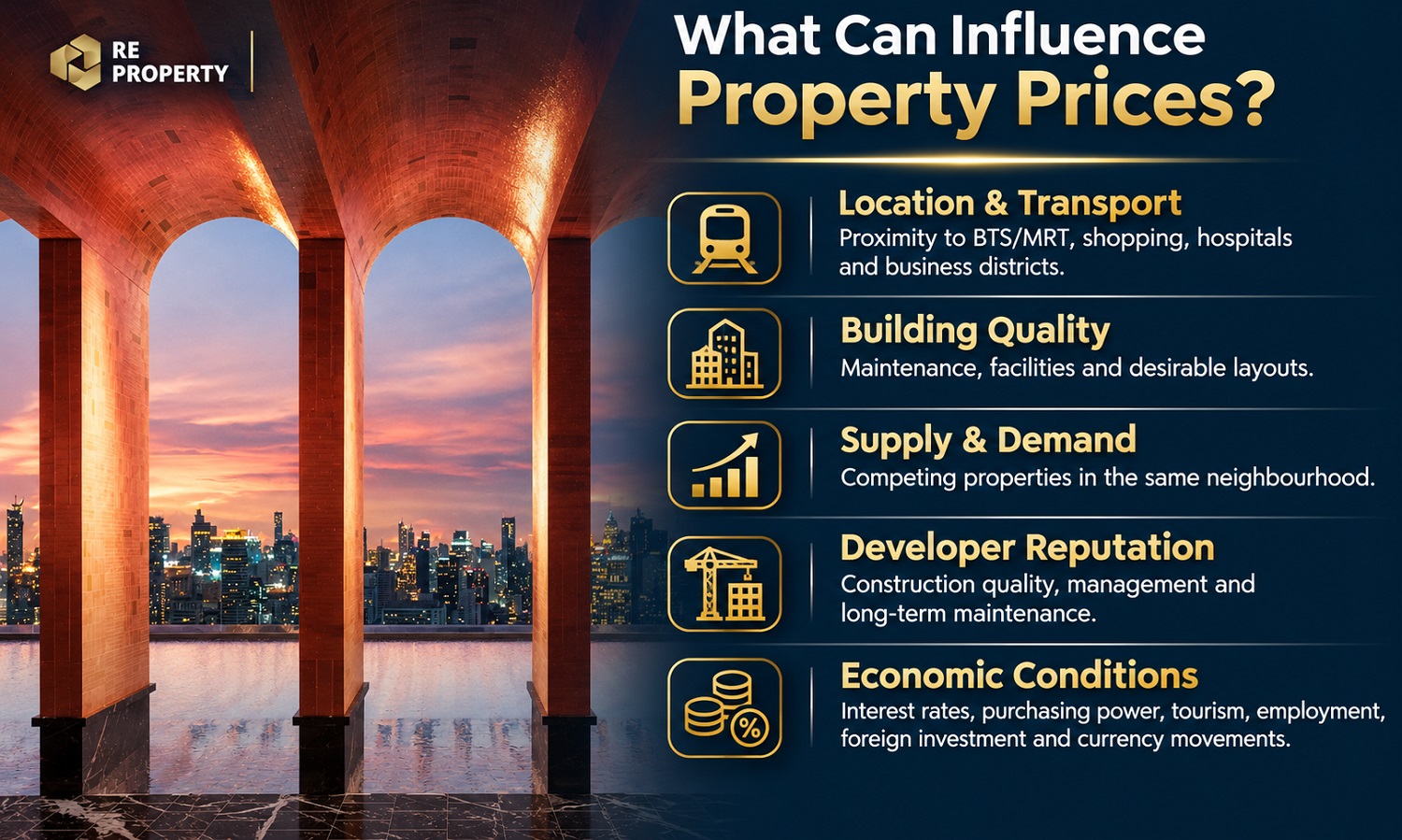
One of the biggest questions for foreign buyers is whether a Bangkok condominium will be worth more in five or ten years.
The honest answer is that nobody can guarantee future property prices.
Bangkok has several established residential markets, but not every location or condominium performs in the same way. A premium property in a well-connected neighbourhood may have different resale prospects from a unit in an area with a large supply of competing developments.
Not necessarily.
Luxury properties can attract a specific group of buyers and tenants, but they also require a larger initial investment. Some high-end developments may maintain strong demand, while others may experience longer selling periods or price adjustments.
For this reason, buyers should evaluate individual projects rather than assuming that an expensive condominium will automatically appreciate.
A useful approach is to compare:
Our advice: Buy a property because it meets your housing or investment objectives at a reasonable price, not because you expect guaranteed capital appreciation.
Yes. Foreign owners can generally rent out qualifying condominium units, subject to Thai law, the lease agreement, and the condominium’s regulations.
For many buyers, rental income is an important consideration because they may not live in Thailand throughout the year.
Bangkok has different rental markets depending on location, property size, building quality, and tenant demand.
Location | Typical tenant profile |
|---|---|
Phrom Phong | International professionals, couples and families |
Thonglor | Professionals, executives and lifestyle-focused residents |
Ekkamai | Professionals, couples and longer-term residents |
Asoke | Business professionals and people seeking transport convenience |
Sathorn | Corporate employees, executives and professionals |
Wireless Road / Langsuan | Premium residential tenants and executives |
These are general market segments, not guarantees of tenant demand or rental performance.
Rental income depends on the property and the market at the time of letting.
For example, consider a condominium purchased for THB 8 million and rented for THB 35,000 per month.
This is an important point for investors.
Owning a condominium does not automatically allow you to rent it to tourists by the night or week.
Short-term paid accommodation can fall under Thailand’s Hotel Act and related licensing requirements. The legal position for ordinary registered condominium units is restrictive, and a condominium should not be assumed to be eligible for hotel-style rental operations.
Longer-term residential leases, commonly arranged for 30 days or more, are a different proposition, although the building regulations and applicable legal requirements must still be checked.
Thaipedia+2
If rental income is part of your buying strategy, ask the building management and your lawyer about permitted rental arrangements before purchasing.
Furnishing and replacement of appliances.
The rental figure advertised by an agent is not necessarily the amount an owner will receive after expenses.
Yes. Foreigners who legally own qualifying condominium units can generally sell their properties, subject to applicable ownership, transfer, and tax rules.
You do not have to remain in Thailand permanently simply because you own a condominium.
However, resale should be considered before purchasing, not only when you decide to leave.
The usual process involves:
Depending on the circumstances of the seller and transaction, the transfer may involve:
The applicable amounts depend on the transaction and the seller’s circumstances. The sale agreement should clearly establish who is responsible for each cost.
Generally, foreign investment funds and proceeds from eligible investments can be transferred across borders through authorised financial institutions, subject to applicable documentation and banking requirements.
The Bank of Thailand provides guidance on foreign exchange regulations and the repatriation of investments.
For a foreign condominium owner, retaining the original purchase documentation and bank transfer evidence can make future financial transactions easier.
Before selling, ask your bank and lawyer which documents will be needed to transfer the proceeds abroad.
This is a particularly important question for people who want a long-term home in Thailand but are not certain they will stay forever.
Your condominium ownership and immigration status are separate.
For example, imagine you purchase a condominium in Sukhumvit and live in Bangkok for five years. Later, you decide to return to your home country or relocate to another destination.
Your visa may expire, but that does not automatically mean you lose your qualifying property ownership.
Depending on your circumstances, you may:
You should continue to meet applicable ownership, tax, and building obligations even when living overseas.
This is one reason why buyers should consider the resale and rental potential of a property before making a purchase.
There is no universal answer. The decision depends on how long you intend to live in Thailand, your financial position, and whether you value flexibility or ownership.
Consideration | Renting | Buying |
|---|---|---|
Initial financial commitment | Lower | Higher |
Flexibility to relocate | Higher | Lower |
Property ownership | No | Yes, if qualifying freehold |
Maintenance | Depends on lease | Owner responsibilities |
Rental income | No | Potentially |
Capital appreciation | No direct benefit | Possible, not guaranteed |
Resale responsibility | None | Yes |
Visa benefit | No automatic benefit | No automatic benefit |
Imagine you are considering a condominium in Bangkok with a purchase price of THB 8 million.
A comparable property might be available for rent at THB 35,000 per month.
Your annual rent would be THB 420,000.
Over five years, that would amount to THB 2.1 million, excluding any rental increases.
Buying the condominium would require a much larger initial financial commitment, along with ownership costs and the opportunity cost of the money invested.
However, the buyer would own the property and might benefit from rental income or future resale proceeds.
This is not enough information to determine which option is financially better. You would also need to consider:
For someone staying in Thailand for only one or two years, renting may offer more flexibility. For someone planning to live in Bangkok for a much longer period, purchasing may deserve closer consideration.
No. Purchasing a condominium does not automatically grant a Thai visa or permanent residency. However, qualifying property investment may count towards the investment requirements of certain programmes, such as the LTR Wealthy Global Citizen category.
For the LTR Wealthy Global Citizen category, the published criteria include at least USD 500,000 in qualifying Thai investments and at least USD 1 million in total assets, alongside additional requirements. This is not a general property-purchase visa.
A foreigner can generally own an individual qualifying condominium unit on a freehold basis. However, the total foreign ownership in the condominium building must remain within the 49% foreign ownership quota.
Yes. Foreigners can generally purchase qualifying condominium units without being Thai residents, provided they meet the applicable ownership, financial transfer, and registration requirements.
Property ownership alone does not grant permanent residency. Permanent residency has separate immigration eligibility requirements and an application process.
You can generally sell your qualifying condominium, subject to the applicable legal and transfer requirements. The sale price and time required to find a buyer depend on market demand, location, property condition, and pricing.
Generally, eligible investment proceeds can be transferred overseas through authorised financial institutions, subject to banking and foreign exchange documentation requirements.
Yes, long-term residential rentals are generally possible, subject to applicable law and condominium regulations. Short-term tourist rentals may require hotel licensing and should not be assumed to be permitted in ordinary condominiums.
Yes, you can own a qualifying condominium and separately apply for an eligible retirement visa if you meet its requirements, including the applicable age and financial conditions.
Your visa expiry does not automatically cancel your qualifying condominium ownership. You may generally retain, rent, or sell the property, subject to applicable laws and ownership obligations.
It can be suitable for some buyers, but returns are not guaranteed. Location, purchase price, building quality, rental demand, maintenance costs, and future supply all influence investment performance.

For some foreigners, buying a condominium in Thailand can be a practical long-term housing decision. For others, renting may be more suitable.
The important thing is to understand what you are actually buying.
A condominium can provide a home, potential rental income, and an asset that may be sold in the future. However, it does not automatically provide immigration benefits, guaranteed appreciation, or a guaranteed rental return.
If your main reason for purchasing is to qualify for a particular visa, check the immigration criteria before committing to the property. If your main reason is investment, carefully evaluate the purchase price, rental market, ownership costs, and resale prospects.
Bangkok offers a broad range of residential options, from modern condominiums near the BTS and MRT to spacious family residences, duplexes, triplexes, and luxury penthouses.
The right choice depends on your plans, your budget, and how you want to experience life in Thailand.
At RE PROPERTY, we help international buyers and residents explore residential opportunities across Bangkok, including premium condominiums and luxury properties in some of the city’s most established neighbourhoods.
Whether you are considering a long-term home, a property to rent out, or a future investment, understanding the local property market is the first step towards making an informed decision.
Explore available properties with RE PROPERTY: https://reproperty.co.th
Stay informed with the latest expert insights on Bangkok’s thriving real estate market, investment opportunities, and property trends.
To register your property information, please fill out the form below